
A few weeks ago, we published an in-depth feature on masalas, and amongst the best-known ones… we didn’t mention curry, noting that it would be worth devoting a feature to its origins… well, here we are. Let’s find out more together about the origins and history of curry as we know it.
In the West, it is common to talk about it as if it were a single spice… but in fact, what we know and readily find on the market is not one; it is a blend of spices that we cannot even consider a ‘masala’ in the ‘traditional sense’ of the term. Curry is literally a ‘culinary syncretism’ – the result of years of ‘cultural cross-pollination’, interactions, history, encounters, clashes and exchanges with other cultures. We could describe it – though not in the most flattering terms – as a colonial product, but its history is far more complex and, contrary to what some claim, it is not ‘a British invention’.
Let’s start with the name: the word ‘curry’ derives from the Tamil term ‘kary’, which literally refers to a spicy sauce to be eaten with rice.
Its origins date back to well before the arrival of the British and French colonists, to the time of the Portuguese, who first introduced chillies, pepper and vinegar to the markets of the Indian subcontinent. These ingredients paved the way for experimentation with new dishes and recipes – attempts that would eventually lead to the curry as we know it today,
born out of the adaptation of local recipes to European tastes.
The most popular curry dishes
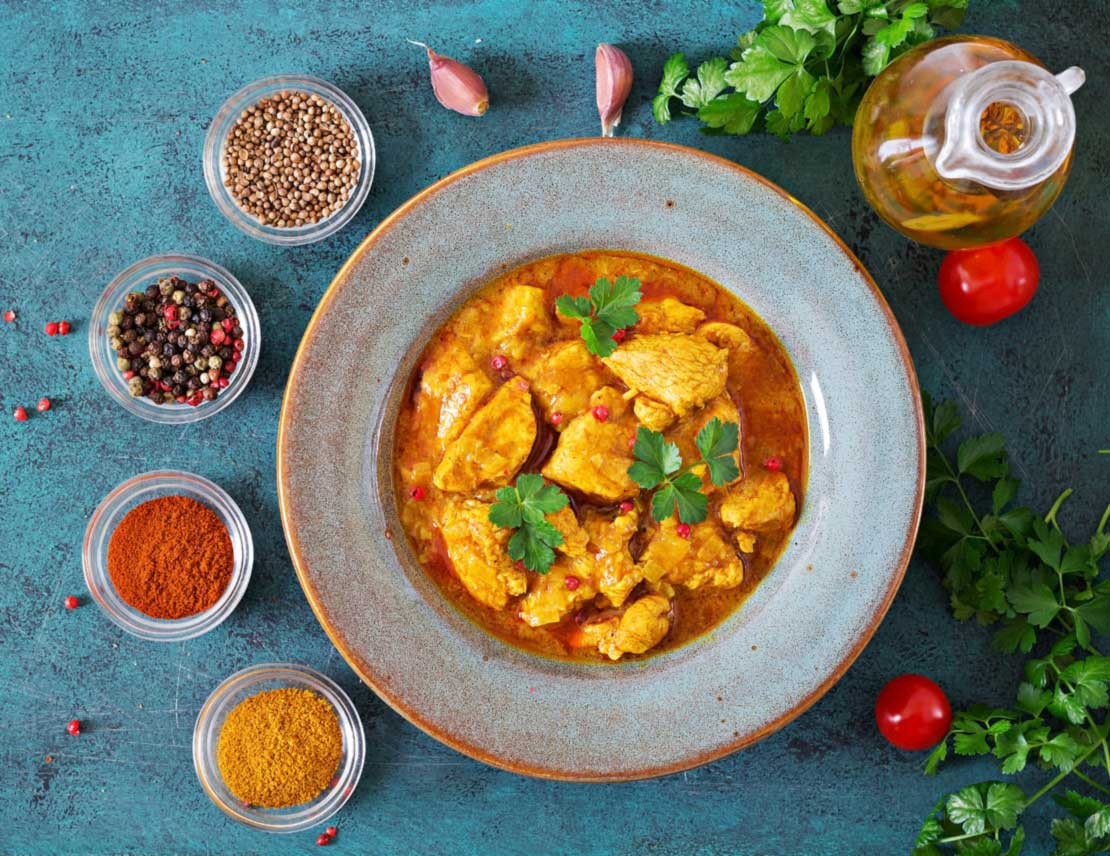
You’ve no doubt tried the famous curry rice, whether with chicken or beef; curry is a blend of spices that lends itself to the preparation of countless dishes that are easy to cook and full of flavour.
What spices are in curry?
There are several variations of the mix; in our shop, for example, you can buy an excellent English curry, made with coriander seeds, turmeric, fennel, salt, cumin, garlic, fenugreek, bay leaves, cloves and chilli, or try out other variations.